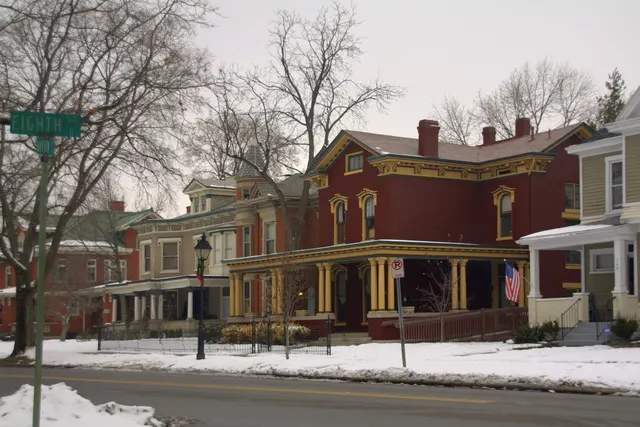
Hamilton, OH facts that affect rodent control
| Hamilton fact | What it means for rats and mice |
|---|---|
| Seat of Butler County, built on both banks of the Great Miami River | The river corridor supports rats near downtown and older neighborhoods. |
| Historic districts include German Village, Dayton Lane and Rossville | 1800s homes with stone foundations and carriage houses take more sealing work. |
| Grew around paper mills and foundries powered by a hydraulic canal | Older industrial land near the river supports rat populations. |
| Calls itself the City of Sculpture | Downtown parks and riverfront green space give rodents cover close to homes. |
Historic Hamilton neighborhoods
Hamilton grew in the 1800s around paper mills, foundries and machine shops along the Great Miami River and its hydraulic canal. The city's historic districts reflect that wealth: German Village and Dayton Lane on the east bank, Rossville on the west, and Lindenwald to the south, filled with brick and frame homes from the mid-1800s to the early 1900s. Many have stone or brick foundations, cellars, porches and carriage houses.
Those older foundations are the main way rodents get in. Mortar washes out between stones, old cellar windows rot, and generations of utility lines leave holes through the masonry. Mice follow those gaps into the walls and up to the kitchen and bedrooms.
The Great Miami River through town
The Great Miami runs right through the middle of Hamilton, lined by levees, parks and the Great Miami River Trail. Like other Miami Valley cities, Hamilton rebuilt its flood defenses after the 1913 flood. The river corridor gives rats cover and travel routes, and homes within a few blocks of the river, rail lines and older industrial land see more rat activity.
How rodent control works in Hamilton
- Inspect the yard, porches, carriage house or garage, and foundation, then the cellar, kitchen and attic.
- Trap along runways inside; place locked stations outside along the foundation and garage if rats are present.
- Seal the foundation with mortar matched to the old masonry, close cellar windows and coal chutes, and pack utility gaps.
- Come back within two weeks to empty traps and check for fresh droppings.
See rat removal and mouse control for the full process.
What rodent control costs in Hamilton
In Hamilton, a mouse trapping program typically costs $200 to $450 and rat removal $250 to $600. Sealing an older house in German Village, Dayton Lane or Rossville often runs $700 to $1,800 because of stone foundations, porches and carriage houses. Newer homes on the edges of the city are usually $300 to $800.
Newer neighborhoods and farmland edges
Hamilton's outer neighborhoods and the surrounding Butler County townships include postwar and newer subdivisions bordered by fields and wooded creeks. Mice from that open land move into attached garages and basements every fall. The fix is the same as in any newer suburb: seal the garage door corners, the door into the house and the utility gaps before September.
Tips for Hamilton homeowners
Check under porches for burrows and droppings each spring and fall. Keep trash carts closed and away from walls. Move birdseed and kibble into metal containers. In historic homes, look along the cellar walls where floor joists meet the masonry for gaps. If you rent, tell the landlord in writing.
Hamilton rodent calendar
In Hamilton, mice start moving into garages and cellars in late September and October, with the heaviest activity from November through February. Rats along the Great Miami River corridor are most visible outside from spring through fall, when they dig burrows under porches and along garage slabs. Spring is a good time to look for new burrows; late summer is the best window for masonry sealing on older homes, when mortar cures well.
Rentals and multi-family homes in Hamilton
Many older Hamilton homes, especially in the East End and North End, have been split into apartments or doubles. Mice move freely between units through shared walls and basements, so treating one unit rarely works for long. Landlords get the best results by treating and sealing the whole building at once, and tenants should report rodents in writing with dates and photos. Ohio landlords are generally responsible for keeping rental units fit and habitable.
Where to start the inspection in a Hamilton home
In German Village, Dayton Lane and Rossville homes, the inspection starts in the cellar, along the top of the stone foundation where the floor joists rest, because that is where most mice enter. Porches and carriage houses come next. In newer homes on the edges of town, the garage door and the A/C line are usually the first places checked. Either way, ask for a written list of entry points and the material used to close each one.
Typical Hamilton rodent jobs and price ranges
What Hamilton calls usually turn into, with typical ranges:
| Situation | Typical range | What it includes |
|---|---|---|
| Mice in a German Village home's cellar and walls | $800–$2,000 | Trapping plus stone foundation and porch sealing |
| Rats under a detached garage near the river | $300–$700 | Exterior stations, burrow treatment and slab-edge sealing |
| Mice in a newer home's garage on the edge of town | $250–$600 | Trapping, door seal and utility-line sealing |
Hamilton neighborhoods we cover
- German Village
- Dayton Lane
- Rossville
- Lindenwald
- Downtown Hamilton
- East End
- North End
- Highland Park