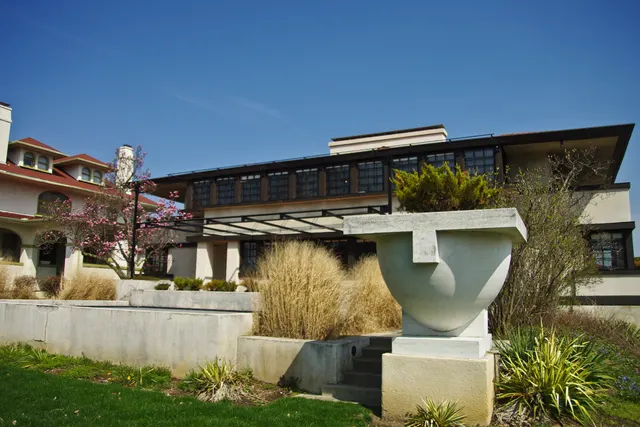
Springfield, OH facts that affect rodent control
| Springfield fact | What it means for rats and mice |
|---|---|
| Seat of Clark County on the old National Road (US 40) | Its 1800s homes along East High Street have stone foundations that need mortar sealing. |
| Grew rich in the late 1800s making farm machinery | Large historic homes have hidden spaces, like servants' stairs, that mice use between floors. |
| Buck Creek runs through the city, with the Mad River just south | Creek banks and storm drains carry rats into nearby neighborhoods. |
| Home to Wittenberg University | Rentals near campus see frequent mouse problems at turnover. |
| Surrounded by Clark County farmland | Each fall's harvest pushes field mice into garages around the outskirts. |
Springfield's historic housing
Springfield grew rich in the late 1800s making farm machinery, and the money built large brick and frame homes along East High Street and near Wittenberg University, along with neighborhoods of smaller worker houses closer to the factories. Many of these homes have stone or brick foundations, full basements, old coal chutes, front porches and detached garages or carriage houses.
In houses that old, rodents have plenty of options: washed-out mortar between foundation stones, old cellar windows, gaps under porches, and openings around utility lines added through masonry over the decades. Larger historic homes also have hidden spaces, like servants' stairs and old dumbwaiter shafts, that mice use as highways between floors.
Buck Creek and the Mad River
Buck Creek runs through the middle of Springfield, with parkland and trails along its banks, and the Mad River runs just south of the city. Creek banks and storm drains are classic rat routes. Homes within a few blocks of Buck Creek, the rail lines and the older industrial areas tend to see more rats than homes on the suburban edges.
How rodent control works in Springfield
- Inspect the yard, garage or carriage house, porch and foundation, then the basement, kitchen and attic.
- Set traps inside along runways and locked stations outside if rats are present.
- Seal the foundation with mortar, cover old cellar windows and coal chutes with metal, and pack utility gaps with copper mesh.
- Return in about a week to clear traps and check that activity has dropped.
In a historic home, ask for sealing that fits the house: mortar matched to the old foundation and metal mesh set behind trim so it does not show.
What rodent control costs in Springfield
Springfield prices tend to be at or a bit below the Ohio average. Expect roughly $200 to $450 for mouse trapping and $250 to $600 for rats in Springfield. Sealing an older home with a stone or brick foundation commonly costs $600 to $1,600, more for large historic homes with porches and carriage houses.
Farmland around Clark County
Springfield is surrounded by corn and soybean fields, and the fall harvest sends field mice toward homes on the edges of the city and in the surrounding townships. Expect a jump in mouse activity in garages and basements from late September through November. Our guide on why mice come inside in the fall has a month-by-month plan.
Tips for Springfield homeowners
Close cart lids and park carts away from the garage wall. Put pet food and seed in metal bins with tight lids. Check under the front porch for burrows and droppings. In the basement, look along the top of the foundation wall with a flashlight for gaps and droppings. Renters should report rodents to the landlord in writing; Ohio landlords are generally responsible for keeping units fit and habitable.
Springfield rodent calendar
In Springfield, field mice move into garages and basements in late September and October as the Clark County harvest comes in, and activity stays high indoors through winter. Rats along Buck Creek and in older neighborhoods with alleys are most visible outdoors from spring through fall. Late summer is the best time for masonry sealing on older homes, and spring is a good time to check under porches and along garages for burrows.
Rentals near Wittenberg and downtown
Many older Springfield homes near Wittenberg and downtown are rented, some as doubles or apartments. Because mice cross between units through shared cellars and walls, treating the whole building is the reliable fix. Tenants should report rodents in writing; landlords with several properties often save by having them all sealed before fall.
Snyder Park, Buck Creek and green space
Springfield has a lot of green space along Buck Creek, including Snyder Park and the trail corridor that runs through town toward Buck Creek State Park. Wooded edges and creek banks shelter deer mice and give rats cover close to homes. If your house sits near one of these corridors, keep firewood and brush away from the foundation, close the garage at night, and check the base of the garage and porch for holes each spring and fall.
Typical Springfield rodent jobs and price ranges
Common Springfield jobs and what they usually cost:
| Situation | Typical range | What it includes |
|---|---|---|
| Mice in a historic East High Street home | $800–$2,000 | Trapping plus stone foundation and porch sealing |
| Rats near Buck Creek under a garage | $300–$650 | Stations, burrow treatment and slab-edge sealing |
| Mice in a student rental near Wittenberg | $300–$800 | Trapping, cleanup and sealing between tenants |
Springfield neighborhoods we cover
- Downtown Springfield
- East High Street historic area
- South Fountain
- Ridgewood
- Northridge area
- Snyder Park area
- Wittenberg area
- Buck Creek area