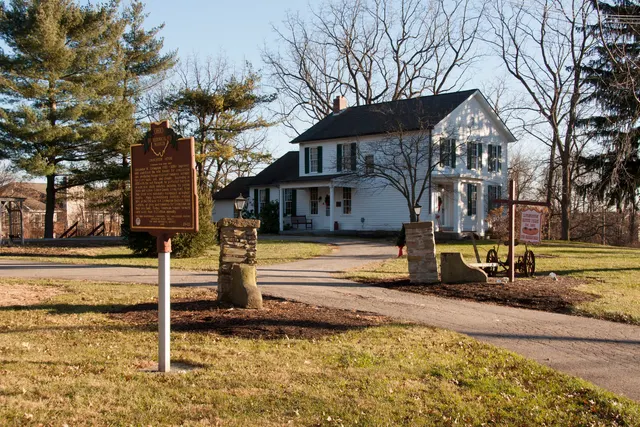
Reynoldsburg, OH facts that affect rodent control
| Reynoldsburg fact | What it means for rats and mice |
|---|---|
| Alexander Livingston developed the first commercial tomato varieties here in the 1870s | Olde Reynoldsburg's oldest homes date from that era and have aging foundations. |
| Spans Franklin, Licking and Fairfield counties east of Columbus | Most homes are 1960s to 1990s builds with garages, weep holes and crawlspace vents to seal. |
| Blacklick Creek runs through the city | The wooded creek corridor holds field and deer mice. |
| Large share of apartments and condos | Mice move between units, so whole-building treatment works best. |
Reynoldsburg's housing and its weak spots
Reynoldsburg's small historic core, Olde Reynoldsburg, dates back to the 1800s, when local seedsman Alexander Livingston developed the first commercially successful tomato varieties there. Most of the city grew later, from the 1960s through the 1990s, with ranches, split-levels and two-story homes on curving streets, plus many apartment and condo complexes.
Homes from the 1960s and 1970s now have aging garage door seals, crawlspace vents, weep holes in brick and gaps around utility lines that let mice in. Newer homes mostly leak at the garage and where the A/C line enters the wall.
Blacklick Creek and green corridors
Blacklick Creek winds through Reynoldsburg with parks and wooded strips along its banks. Those green corridors are home to field mice and deer mice, and homes backing onto them see more mouse activity in fall. Rats occasionally use creek banks too, especially near commercial areas along Brice Road and Main Street.
Apartments and condos
Reynoldsburg has a large share of apartments and condominiums. In these buildings, mice move between units through shared walls, utility chases and attics, so treating a single unit rarely solves the problem. The building owner or HOA usually arranges treatment for the whole building. Tenants should report activity in writing with dates and photos.
What rodent control costs in Reynoldsburg
For a single-family home, a mouse trapping program usually costs $200 to $450 and rat removal $250 to $600. Sealing a 1960s or 1970s home typically runs $400 to $1,000; a newer home often $300 to $700. Whole-building treatment for condos and apartments is priced by the building.
How a Reynoldsburg rodent job works
- Inspect the outside of the house, the garage, crawlspace or basement, kitchen and attic.
- Indoor snap traps on runways; outdoor locked stations if rats turn up.
- Seal the garage, crawlspace vents, weep holes, sill plate and utility gaps.
- Follow up in one to two weeks to clear traps and check for new activity.
More on each step is on our mouse control and rodent proofing pages.
Tips for Reynoldsburg homeowners
Replace a worn garage door seal before fall. Check crawlspace vents for torn screens. Keep birdseed and pet food in metal cans. If your yard backs onto Blacklick Creek, keep firewood away from the house and a clear strip along the foundation. And if you are not sure whether you have rats or mice, see our rats vs mice guide.
Reynoldsburg rodent calendar
Mice start moving into Reynoldsburg garages and crawlspaces in late September and October as nights cool and fields east of the city are harvested. Activity stays steady through winter. Rats near Blacklick Creek and the commercial strips along Brice Road and Main Street are most visible from spring through fall. Late summer is the best time to seal crawlspace vents, weep holes and garage doors.
Before you call in Reynoldsburg
Check the garage along the base of the walls, under the kitchen sink and behind the stove. If your home has a crawlspace, look in with a flashlight for droppings on the vapor barrier or torn insulation, without disturbing anything. In a condo or apartment, note which rooms have activity and whether neighbors have mentioned mice. All of that helps the technician plan the visit.
Crawlspaces in Reynoldsburg homes
Many 1960s and 1970s Reynoldsburg ranches sit on crawlspaces. Torn vapor barriers, rusted vent screens and loose access doors make them easy for mice to enter, and the space stays sheltered all winter. Sealing vents with metal mesh, fitting a tight access door and replacing a torn barrier are often part of a complete job here.
Older homes in Olde Reynoldsburg
The homes along Main Street and the streets around it in Olde Reynoldsburg are the oldest in the city. Their stone and early block foundations, cellars and porches let mice in through mortar gaps and old windows, and rats occasionally burrow under porches near the creek. Sealing these homes takes mortar and sheet metal, and the inspection should include the cellar walls and the space under the porch as well as the garage.
Typical Reynoldsburg rodent jobs and price ranges
What Reynoldsburg calls usually turn into, with typical ranges:
| Situation | Typical range | What it includes |
|---|---|---|
| Mice in a 1970s ranch with a crawlspace | $450–$1,100 | Trapping plus crawlspace vents, access door and barrier repair |
| Mice in a condo building | Priced per building | Coordinated trapping and sealing across units |
| Rats near Blacklick Creek | $300–$650 | Exterior stations and burrow treatment |
Reynoldsburg neighborhoods we cover
- Olde Reynoldsburg
- Blacklick Creek area
- Brice Road corridor
- Livingston Avenue area
- Main Street corridor
- Taylor Road
- Huber Village area
- Rosehill Road