Newark, OH facts that affect rodent control
| Newark fact | What it means for rats and mice |
|---|---|
| Seat of Licking County, where the North and South Forks form the Licking River | Riverbanks and bottomland support rats near older neighborhoods. |
| Home of the Newark Earthworks, ancient Hopewell mounds | Large open grounds near homes hold field mice that move in each fall. |
| Grew as a canal, rail and glassmaking town | Older worker homes have stone or block basements that need mortar sealing. |
| Western Licking County is growing fast with new industrial projects | Land clearing displaces mice toward newer subdivisions. |
Newark's older housing
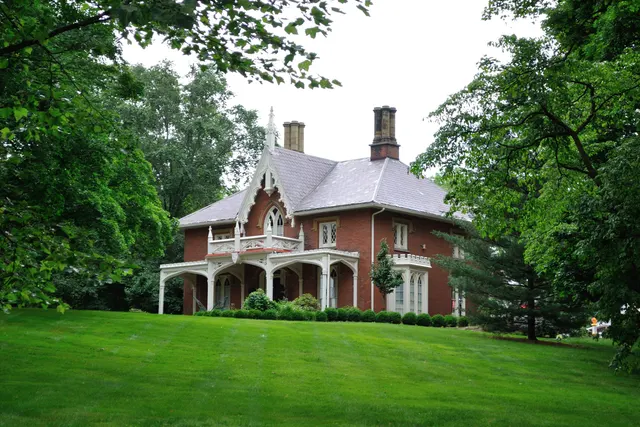
Newark grew as a canal and railroad town in the 1800s and later as a glassmaking and manufacturing center. Neighborhoods around the courthouse square and on the north, east and west ends are full of frame and brick homes from the late 1800s through the 1940s, many with stone or block basements, porches and detached garages.
In houses of that age, mice come in through mortar gaps, old basement windows and coal chutes, and around utility lines, then climb the walls to kitchens and bedrooms. Rats tend to burrow under garage slabs and porches.
The Licking River forks
The North Fork and South Fork of the Licking River meet in Newark, and the river corridors, with their wooded banks, flood-prone bottoms and rail lines, give rats cover and travel routes. Homes within a few blocks of the river see more rats than those on the hills. Deer mice and field mice live along the wooded banks and move into nearby garages each fall.
Growth on the west side
Licking County's western edge, near Columbus and the large new industrial and technology developments around New Albany and Johnstown, has seen rapid growth. Newer subdivisions around Newark and Heath sit next to farmland, and field mice from those fields find the gaps at garage doors and utility lines every fall.
What rodent control costs in Newark
In Newark, a mouse trapping program usually runs $200 to $450 and rat removal $250 to $600. Sealing an older home with a stone or block basement typically costs $500 to $1,400. Newer homes are often $300 to $700. Homes near the river may benefit from ongoing exterior stations at about $35 to $70 a month.
How rodent control works in Newark
- Walk the lot, garage, porch and foundation first, then work through basement, kitchen and attic.
- Traps go along inside runways; locked stations go outside for rats.
- Seal foundation gaps, old windows and utility lines with mortar, mesh and metal.
- A return trip one to two weeks out removes catches and verifies the sealing.
Details are on our rodent proofing page.
Tips for Newark homeowners
Keep cart lids shut and the carts a few feet off the garage. Swap feed bags for metal cans with lids. Check under porches and along the garage slab for burrows each spring and fall. If you live near the river, keep a clear strip along the foundation so holes are easy to spot.
Newark rodent calendar
In Newark, field mice move into garages and basements from late September through November, with the farmland edges and homes near the Licking River seeing the most. Activity stays steady indoors through winter. Rats along the river and rail lines are most visible from spring through fall. Spring high water on the Licking River can push rats out of low burrows toward nearby homes, so a spring check of the foundation and garage is worthwhile.
Rentals and older homes in Newark
Newark has many older rentals, including doubles and houses split into apartments near downtown. Mice move between units through shared basements and walls, so whole-building treatment works best. Tenants should report rodents in writing with dates and photos. Landlords with several properties often save by having them all inspected and sealed before fall.
Before you call in Newark
Check under the kitchen sink and behind the stove for droppings, look along the basement walls with a flashlight, and walk the garage and porch for burrows. Rice-sized droppings mean mice; raisin-sized mean rats. Telling the technician what you found helps them plan the first visit.
The North End and East End
Newark's North End and East End neighborhoods are filled with older frame homes, many over a century old, with stone or block foundations, porches and detached garages. Mice get in through mortar gaps and old basement windows; rats sometimes burrow under porches and garage slabs, especially closer to the river. Sealing these homes is mostly masonry and garage work, and the inspection should cover the porch and garage as well as the basement.
Typical Newark rodent jobs and price ranges
Common Newark jobs and what they usually cost:
| Situation | Typical range | What it includes |
|---|---|---|
| Rats under a porch near the Licking River | $300–$650 | Burrow treatment, stations and porch screening |
| Mice in a North End home's basement | $450–$1,200 | Trapping plus foundation and window sealing |
| Field mice in a newer west side garage | $250–$600 | Trapping, door seal and utility gaps |
Newark neighborhoods we cover
- Downtown Newark and Courthouse Square
- North End
- East End
- West End
- South Newark
- Earthworks area
- Licking River area
- Moundbuilders area